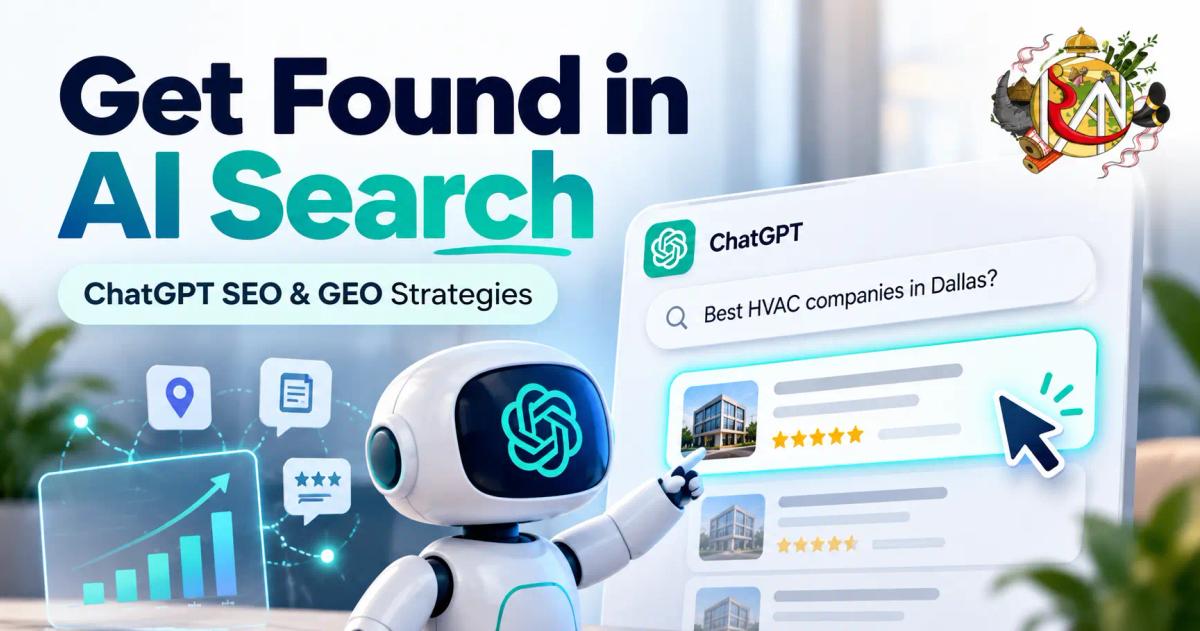
Search is changing.
For years, businesses focused on ranking on Google for keywords such as “best digital marketing agency,” “best dentist near me,” or “HVAC companies in Dallas.” But users are increasingly asking the same questions directly to AI tools such as ChatGPT, Google AI Overviews, Microsoft Copilot, Perplexity, and other AI search platforms.
Instead of browsing ten websites, a user may simply ask:
“What are the best HVAC companies in Dallas?”
The AI then generates a shortlist of businesses that it considers relevant.
This has created a new area of digital marketing commonly called ChatGPT SEO, AI SEO, or Generative Engine Optimization (GEO).
The goal is no longer only to rank a webpage on Google. Businesses also need to become visible, credible, and mention-worthy in AI-generated answers.
But how does ChatGPT decide which businesses to mention?
And what can you do to increase your chances of being recommended?
What Is ChatGPT SEO?
ChatGPT SEO is the process of improving a business's online presence so that AI search and answer engines are more likely to understand, trust, and mention the business in relevant responses.
Traditional SEO focuses heavily on search-engine rankings.
ChatGPT SEO focuses on AI visibility.
For example, traditional SEO might target:
“best HVAC companies in Dallas”
The objective is to rank a website on Google's first page for that query.
With ChatGPT SEO, the objective is broader. You want your business to appear when someone asks an AI assistant:
“Which HVAC companies in Dallas are highly rated?”
“What are some reliable HVAC companies in Dallas?”
“Who provides emergency AC repair in Dallas?”
“What are the best HVAC companies for residential services in Dallas?”
AI search optimization therefore requires more than keyword placement. It requires a strong digital footprint across multiple trusted sources.
Why Does AI Search Matter for Businesses?
The way people discover businesses is changing.
Users are increasingly using conversational queries instead of traditional keyword searches. They may describe their problem, provide several requirements, and ask an AI tool to recommend businesses that meet those requirements.
For example:
Traditional search:
“Dallas HVAC company”
AI search:
“I need an HVAC company in Dallas that provides emergency AC repair, has good customer reviews, and serves residential customers. Which companies should I consider?”
The second query contains much more context.
AI systems need to identify businesses that are relevant to the location, service, industry, reputation, and other criteria mentioned in the question.
This means businesses need to build a strong and consistent online presence that AI systems can understand.
How Does ChatGPT Choose Businesses to Mention?
There is no single public formula that guarantees a business will be recommended by ChatGPT.
AI systems can use information from different sources and may rely on factors such as relevance, authority, reputation, available information, location, and the context of the user's question.
Depending on the AI platform and query, information may come from websites, business directories, review platforms, news publications, industry websites, social platforms, and other online sources.
This is why simply adding “best company” to your website repeatedly is not enough.
AI visibility is about entity recognition, relevance, authority, and corroboration.
In simple terms:
The more clearly the internet establishes what your business does, where it operates, and why it is credible, the easier it becomes for AI systems to understand your business.
10 Ways to Improve Your ChatGPT SEO
1. Build a Strong and Clear Business Entity
The first step is making sure your business has a consistent identity across the internet.
Your business name, website, location, services, contact information, and other important details should be accurate and consistent.
For example, if your website describes your company as:
“A residential HVAC company serving Dallas and surrounding areas”
your other important online profiles should communicate the same basic information.
Avoid unnecessary variations in your business name or service descriptions.
A consistent digital identity helps search engines and AI systems connect information from different sources to the same business.
2. Create Content That Answers Real Questions
AI search is heavily driven by questions.
People do not always search using short keywords. They ask complete questions.
For example:
- What are the best HVAC companies in Dallas?
- How much does AC repair cost in Dallas?
- How often should an HVAC system be serviced?
- Which HVAC company offers emergency service?
- What should I check before hiring an HVAC contractor?
Create useful content around these questions.
Instead of producing dozens of thin articles targeting slightly different keywords, create comprehensive pages that genuinely answer the questions customers ask.
A good article should provide:
- A direct answer
- Supporting information
- Practical examples
- Relevant statistics where appropriate
- Clear explanations
- Internal links to related services
- Information about your business where relevant
The goal is to become a useful source of information, not simply to insert keywords.
3. Target Conversational Search Queries
Traditional keyword research remains important, but AI search requires you to think beyond conventional keywords.
Consider the questions your customers might ask an AI assistant.
For example, a dentist could create content around:
Traditional keyword:
emergency dentist Dallas
Conversational queries:
What should I do if I have a severe toothache at night?
How do I find an emergency dentist in Dallas?
Which dental treatments require an emergency appointment?
Similarly, a digital marketing agency could target:
How much does local SEO cost for a small business?
How long does Google Maps SEO take?
What should I look for when hiring a local SEO agency?
These questions can help your website become relevant to a wider range of AI-generated queries.
4. Strengthen Your Google Business Profile
For local businesses, Google Business Profile remains extremely important.
Make sure your profile contains accurate information about:
- Business name
- Address
- Phone number
- Website
- Business category
- Services
- Opening hours
- Service areas
- Photos
- Customer reviews
Your website and Google Business Profile should tell a consistent story about the business.
Reviews are particularly useful because they provide third-party information about customer experiences.
However, businesses should never manufacture reviews or manipulate ratings.
Focus on earning genuine reviews from real customers.
5. Get Mentioned on Trusted Websites
One of the strongest ways to build online authority is to earn genuine mentions from relevant websites.
These can include:
- Industry publications
- Local news websites
- Business directories
- Professional organizations
- Local publications
- Relevant blogs
- Review platforms
- Partner websites
- Community websites
Think about it this way:
If ten unrelated websites independently describe your company as a reputable HVAC provider in Dallas, that creates a stronger online footprint than your own website making the same claim ten times.
This is why digital PR, link building, citations, and brand mentions can play an important role in AI visibility.
Quality matters more than simply collecting a large number of links.
6. Build Brand Mentions, Not Just Backlinks
Traditional SEO often focuses heavily on backlinks.
AI search requires a broader approach.
A business can benefit from being mentioned even when the primary objective is not obtaining a traditional SEO backlink.
For example, your company could be mentioned in:
“Five local HVAC companies serving homeowners in Dallas”
or:
“Local businesses providing emergency AC repair in Dallas”
These mentions help create a broader association between your brand and specific services or locations.
This is why brand visibility should be treated as an important part of your SEO strategy.
7. Create Dedicated Service and Location Pages
If your business operates in multiple locations, make that information easy to understand.
For example, an HVAC company could have pages for:
- AC Repair in Dallas
- Emergency HVAC Service in Dallas
- Furnace Repair in Dallas
- HVAC Maintenance in Dallas
- Commercial HVAC Services in Dallas
But these pages should not be created simply to target keywords.
Each location or service page should contain genuinely useful information.
Explain:
- What services you provide
- Which areas you serve
- Common customer problems
- How your service works
- What customers should expect
- Relevant FAQs
- Business credentials
- Customer experiences
Avoid creating hundreds of nearly identical location pages with only the city name changed.
8. Use Structured Data
Structured data helps search engines understand the information on a webpage.
Depending on the business, relevant schema types may include:
- Organization
- LocalBusiness
- Product
- Service
- Article
- FAQPage
- Person
- Review
For example, LocalBusiness structured data can help communicate important information about a local business.
However, schema markup is not a magic shortcut to AI recommendations.
It should support a broader SEO strategy rather than replace one.
The information in your structured data should accurately match the visible information on your website.
9. Make Your Website Easy for AI Systems to Understand
A complicated website may contain valuable information, but that information still needs to be clearly presented.
Use descriptive headings and logical page structures.
For example:
About Our HVAC Company
HVAC Services We Provide
Areas We Serve
Emergency AC Repair
Why Customers Choose Us
Frequently Asked Questions
This makes the content easier for users to navigate and helps search systems understand the relationship between different pieces of information.
Avoid hiding important business information behind unnecessary design elements.
Clear content is useful for both humans and machines.
10. Develop Topical Authority
One article about your industry is unlikely to establish strong topical authority.
Instead, create a network of useful content around your core services.
For an HVAC company, this could include:
- AC repair
- AC installation
- HVAC maintenance
- Furnace repair
- Indoor air quality
- Emergency HVAC services
- HVAC costs
- Energy-efficient systems
- Thermostat problems
- Common AC problems
- HVAC maintenance schedules
These topics are interconnected.
When your website consistently demonstrates expertise across a subject, it provides search systems with more context about your business.
This is particularly useful for competitive industries.
ChatGPT SEO vs Traditional SEO
Traditional SEO and ChatGPT SEO are not completely separate strategies.
They overlap significantly.
Traditional SEO focuses on helping search engines understand and rank webpages.
AI SEO focuses on helping AI systems understand businesses, content, entities, and their relationships so that they can provide useful answers.
Both strategies benefit from:
- High-quality content
- Strong websites
- Relevant backlinks
- Digital PR
- Brand authority
- Local citations
- Positive reviews
- Technical SEO
- Clear business information
- Strong topical relevance
The major difference is the final objective.
Traditional SEO asks:
“How do I rank for this keyword?”
AI search optimization asks:
“How do I become a credible source or recommendation when someone asks this question?”
Does Ranking #1 on Google Guarantee a ChatGPT Mention?
No.
Ranking highly on Google does not automatically guarantee that ChatGPT or another AI platform will mention your business.
AI systems can use different sources and signals when generating answers.
A business may rank well for a particular keyword but have a relatively weak brand presence across other websites.
Another business may have strong local reputation, reviews, industry mentions, and brand recognition even if it does not rank first for every keyword.
Therefore, businesses should not treat Google rankings and AI visibility as identical metrics.
Instead, track both.
How to Measure ChatGPT SEO and AI Visibility
AI visibility can be difficult to measure because AI responses can vary depending on the query, location, platform, model, and other factors.
However, businesses can create a consistent testing process.
Start with a list of relevant prompts.
For example:
- Best HVAC companies in Dallas
- Best HVAC company for emergency AC repair in Dallas
- Affordable HVAC companies in Dallas
- Top-rated HVAC contractors in Dallas
- Best residential HVAC services in Dallas
Run these prompts periodically across relevant AI search platforms.
Then record:
- Whether your business was mentioned
- Where it appeared in the response
- Which competitors were mentioned
- What sources appeared to influence the answer
- How your business was described
- Whether the information was accurate
Over time, this creates an AI visibility benchmark.
What Is Generative Engine Optimization (GEO)?
Generative Engine Optimization, commonly abbreviated as GEO, refers to optimizing content and online presence for AI-generated search results.
It is closely related to AI SEO and ChatGPT SEO.
The basic objective is to increase the likelihood that your business, website, content, or expertise will be represented accurately and prominently in AI-generated answers.
GEO can include:
- Content optimization
- Digital PR
- Brand mentions
- Entity optimization
- Local SEO
- Review management
- Structured data
- Topical authority
- Relevant backlinks
- Third-party citations
Rather than replacing SEO, GEO is increasingly becoming another layer of modern search optimization.
Common ChatGPT SEO Mistakes to Avoid
Keyword Stuffing
Repeating “best HVAC company in Dallas” dozens of times will not automatically make a business more visible in AI search.
Write naturally.
Creating AI Content Without Expertise
Publishing hundreds of generic AI-written articles can create a large website without creating real authority.
AI can help with content production, but the information should be accurate, useful, original, and reviewed.
Fake Reviews
Do not create fake Google reviews or pay people to post misleading reviews.
A strong reputation should be built through genuine customer experiences.
Buying Low-Quality Backlinks
Thousands of irrelevant backlinks are unlikely to create meaningful authority.
Focus on relevant and trustworthy websites.
Creating Hundreds of Similar Location Pages
Mass-produced location pages can create thin or repetitive content.
Each location page should provide genuine local value.
Making Unsupported Claims
Calling your company “the best” is easy.
Providing evidence of expertise is much more valuable.
Use:
- Case studies
- Credentials
- Awards
- Customer experiences
- Industry experience
- Results
- Relevant third-party mentions
A Simple ChatGPT SEO Strategy for Businesses
If you are starting from scratch, do not try to optimize everything at once.
Follow this process.
Step 1: Define Your Entity
Clearly communicate:
Who are you?
What do you offer?
Where do you operate?
Who do you serve?
Step 2: Research Customer Questions
Find the questions people ask about your services, products, industry, and location.
Step 3: Improve Your Website
Create clear service pages, location pages, About pages, FAQs, and useful informational content.
Step 4: Strengthen Local SEO
Optimize your Google Business Profile, citations, reviews, and local website signals.
Step 5: Earn Third-Party Mentions
Work on digital PR, relevant backlinks, industry publications, partnerships, and genuine brand mentions.
Step 6: Build Topical Authority
Publish useful content around your main areas of expertise.
Step 7: Monitor AI Search
Test relevant prompts regularly and track whether your business is being mentioned.
Step 8: Improve Based on the Results
If competitors consistently appear while your business does not, investigate what information, authority, or relevance signals they have that your business lacks.
The Future of SEO Is Bigger Than Google
SEO is no longer only about ten blue links.
People are discovering businesses through traditional search engines, maps, social platforms, review websites, AI assistants, and increasingly conversational search interfaces.
This does not mean Google SEO is dead.
It means the definition of search visibility is expanding.
Businesses that want to remain competitive should think beyond rankings and focus on becoming a trusted, recognizable entity across the web.
The question is no longer simply:
“How can I rank #1?”
It is also:
“When someone asks an AI who they should choose, will my business be part of the answer?”
That is the opportunity behind ChatGPT SEO.
Final Thoughts
Getting your business mentioned in ChatGPT or another AI search engine is not about finding a secret prompt or manipulating an AI model.
It is about building a strong digital presence that consistently demonstrates relevance, credibility, expertise, and reputation.
Create useful content. Strengthen your local SEO. Earn genuine brand mentions. Build topical authority. Keep your business information consistent. And most importantly, give customers and search systems enough reliable information to understand what makes your business worth considering.
AI search is still evolving, but one principle is likely to remain important:
Businesses that are genuinely useful, credible, and well represented across the web have a better chance of being discovered—whether the search happens on Google or through an AI assistant.